
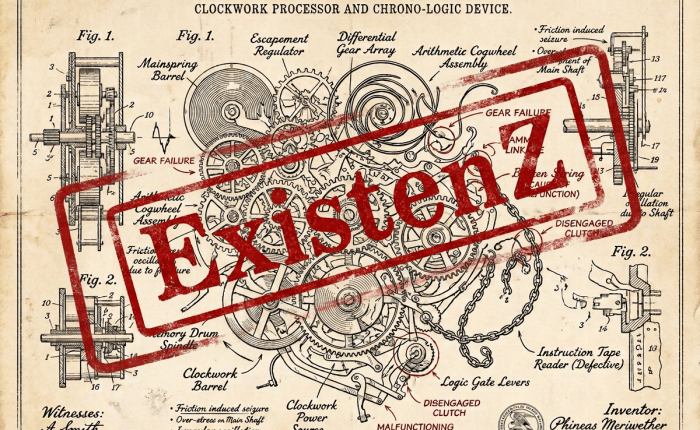
⚠️ NOTICE FOR THE COGNITIVELY FAINT-HEARTED
Warning: The following manifesto contains unbuffered exposures to Karl Popper’s paradoxes, raw Platonic geometry, and absolute, uncompromised honesty regarding human nature. It is structurally incompatible with individuals who prefer the cozy comfort of collective delusions, corporate buzzwords or newspeak and administrative inefficiency.
Read at your own metabolic risk.
The simulation is to be viewed at: https://gowildchild.github.io/Existenz/ where you can see the “paradox of tolerance” is in “automatic mode”, at the right circumstances.
Project Existenz: An Exit Route from the Paradox of Tolerance
It is quite ironic that you can spend your entire life being exceptionally good at solving everyone else’s problems, while your own equations remain the most agonizingly difficult to balance. We do not need to pin a clinical label of autism and ADHD on everyone to validate this reality, but it makes the processing loop not just exponentially harder, but significantly more complicated than a neurotypical mind could ever begin to fathom.
Since a very young age, I began calculating the universe in binary, but not binary as a simplistic sequence of ones and zeros. That would be far too trivial; an immediate end of code, goodbye, until next time. No, binary as an intricate sequence of spatiotemporal events that share the exact same mathematical signatures at the precise same coordinate. One of those internal gates was always locked tight, an isolated sector I called my inner child. Perhaps that is where the soul actually hides?
By the age of seven, my consciousness was already operating strictly through logical gates. This means far more than a basic on-and-off state; it is entirely position-dependent, and it allows for an OR condition. Yet, there are so many of these internal logic gates that remain vulnerable to yourself, gates that can be forcefully toggled by an external observer. It can also occur that certain operations are mutually exclusive, meaning they simply cannot happen simultaneously due to the rigid architecture, such as an XOR NAND gate.
In my quest to assign an objective meaning to these collisions, I was driven as a young boy into the massive works of classical philosophy, systematically devouring thousands of encyclopedias and volumes into my own processing matrix, also called the brain. Several of those books crawled out of the wartime past, a meticulous preoccupation of my father back then. Among those works was Karl Popper’s text, which breaks down the paradox of tolerance. To put it simply: the more tolerant you are toward the outside world, the more the active forces of intolerance will scale up. This is infinitely more fascinating than probability metrics and chaos theory crammed onto the exact same page.
Continue reading “Understanding the Paradox of Tolerance”
